Aggregate
Aggregate and base material
Sub-grade, caliche, limestone, river rock, sand and recycled concrete: the material that goes under and around every pour we load. Call the plant for gradation and quantity; here's what each one is actually for.
Chapter 01
Sub-grade and caliche, the base under everything out here
Caliche is a hard, chalky layer that forms naturally in West Texas soil, calcium carbonate that has cemented the loose ground above it into something close to soft rock. It sits under most of Lubbock a few feet down, sometimes closer, and it's the reason a base out here behaves differently than the same job would in country with a deeper clay or sandy subsoil.
Builders here use caliche on purpose rather than working around it, because once it's broken up, graded and compacted it makes a stable, load-bearing base that doesn't move around the way loose native soil can. Skip the base and go straight from raw ground to concrete and the slab is only as good as whatever unevenness and soft spots were already down there, no matter how strong the mix on top of it is.
Getting the base right is mostly about compaction: packing the material down in even layers rather than one thick lift, so the ground under the slab is uniform before any concrete arrives. We supply the sub-grade and caliche material itself. For the compaction spec your job actually needs, that's a call to the plant or your engineer, not a number we'd guess at here.
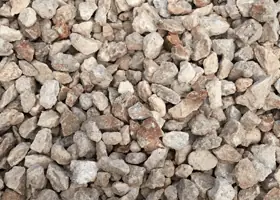
Crushed limestone aggregate with warm caliche staining, close up, from the Triple C Concrete yard in Lubbock.
Which stone for which job
Limestone is the workhorse of the yard, crushed to different sizes and used under slabs, driveways and roads as a base or a drainage layer. River rock is rounder and smoother, taken from a different kind of deposit, and gets bought more for how it looks and drains: dry creek beds, French drains, decorative beds around a building rather than structural base.
Concrete aggregate is the stone and sand that actually goes into a batch of ready-mix, sized and graded to work with the cement and water in the mix itself, different from what you'd order to spread loose. Landscape aggregate is the loose material bought by the yard for the ground around a project rather than for a structure: beds, paths, drainage.
Mortar sand and masonry sand are two different products for two different trades even though they look similar in the pile. Mortar sand is finer and more consistent, sized for the joints between brick or block. Masonry sand covers a broader range and gets used more loosely: fill, bedding, general masonry work where the joint spec isn't as tight. Tell us the job, not the product name, and we'll point you at the right pile.
Chapter 03
The recycled side of the yard
Crushed concrete comes from demolition and old pours we or others have broken up, run back through the crusher and resold as a base material. It compacts and performs like a lot of virgin limestone base for a fraction of the cost, and it keeps material that would otherwise go to a landfill working on the next job instead.
Concrete washout is the other side of that stream, the leftover slurry and rinse water that comes out of a mixer drum after a pour. We handle it on our own yard rather than letting it run off into a ditch or a customer's site, the kind of housekeeping a HUB-certified local supplier gets held to and a large out-of-town outfit doesn't always bother with.
We're not going to invent a gradation number to sound precise. Tell the plant what the job needs and we'll point you at the right pile. Call (806) 745-1111.
Before you call
What the yard needs to price a load of stone or base
None of this is a form to fill in ahead of time. Bring what you have and we'll work the rest out on the phone.
What it's going under
Base beneath a slab, a decorative bed, or backfill behind a retaining wall.
How much ground it covers
Roughly how much area or how many loads, so we can talk you toward a size instead of a guess.
Delivered or picked up
To the site, or bring a trailer to 1521 Erskine Street and load it yourself.
When the crew needs it
Call ahead and we'll fit it into the day's run.
The base decides more than the mix does
We already sell sub-grade and caliche alongside every ready-mix order for exactly this reason. If concrete is part of the same job, put the base material on the same ticket instead of scheduling a second delivery. See how that works on the ready-mix concrete page.
For the full residential, industrial and renewable product groups this yard supplies, see what we supply by industry.
Tell the plant what the ground needs
Call (806) 745-1111 for stone or base priced by the job, or send the details and Matt will call you back.