What's Under Your Slab Matters as Much as What's In It
The ground under a South Plains slab does more work than most people give it credit for.
September 6, 2026 · 3 min read
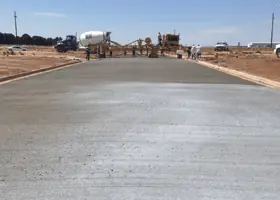
Anybody who's dug a fence post hole in Lubbock knows the ground here doesn't behave like the topsoil in a landscaping catalog. A few inches down, you hit caliche, a chalky, calcium-carbonate-cemented layer that's part of what makes West Texas West Texas. What's under a slab decides how that slab holds up a lot more than most people expect.
What caliche actually is
Caliche forms when calcium carbonate dissolved in groundwater cements soil particles together, usually a foot or two below the surface across the South Plains. In its natural, undisturbed state it can be rock-hard, which sounds like a good thing to build on. The problem shows up when it's broken up: disturbed caliche doesn't compact the same way it sat naturally, and it can hold water differently than the layer around it.
Why sub-grade prep is not optional
A slab is only as good as what's underneath it. If the sub-grade has soft spots, uncompacted fill, or old organic material left in from prior landscaping, the slab above it will settle unevenly over time. That shows up as cracking that has nothing to do with the mix, the finishing, or anything that came off the truck. It's a foundation problem wearing a concrete problem's clothes.
How caliche shows up differently across a single lot
Caliche depth and hardness aren't uniform even across one property. A lot that's been graded, filled, or built on before can have caliche sitting at a different depth in the back corner than it does at the street. New construction and additions are especially prone to this, since fill brought in for one part of a site rarely matches what's native to another. That's part of why a sub-grade check on the actual pour area matters more than assuming the whole lot behaves the same way.
Compaction is the step nobody sees and everybody notices later
Compacting the sub-grade in even lifts, checking for uniform density, and correcting soft spots before the forms go in is the unglamorous part of a concrete job. It happens before the truck ever shows up, and it's one of the biggest factors in whether a slab stays flat for twenty years or starts telegraphing cracks in three.
- Strip organic material, grass, roots, old mulch, down to firm native soil or prepared base
- Compact in lifts rather than one deep pass, especially over disturbed or backfilled caliche
- Check for consistent density across the whole pad, not just the edges
- Correct soft or wet spots with proper base material before forming
When to bring in base material instead of building on native caliche
Sometimes the existing sub-grade is genuinely sound and needs nothing more than compaction. Other times, especially over fill or disturbed ground, it's worth bringing in a proper base layer of crushed limestone or select fill and compacting that instead. We supply sub-grade and caliche material along with limestone base rock for exactly this reason, sold separately from the ready-mix order so a contractor or excavator can spec exactly what the site needs.
Signs a site needs extra sub-grade attention before anyone calls the plant
A few things are worth checking before you ever schedule a pour. Standing water after a rain in the area you're planning to build on is a signal the ground doesn't drain the way you'd want under a slab. Ground that feels noticeably softer or spongier in one spot than the rest of the pad is worth digging into before it's covered up. And any area that's been recently backfilled, whether from a utility trench, an old tree removal, or prior demolition, should be treated as suspect until it's compacted properly, not assumed fine because it looks flat on top.
Get the base right, then order the mix
If you're planning a pour and you're not sure what your sub-grade is telling you, that's a conversation worth having before the concrete order goes in, not after the truck leaves. Call the plant on Erskine Street at 806-745-1111 and ask what they'd recommend for your site. A short conversation about what your soil is doing can save a much longer, much more expensive conversation a few years down the road about why a slab that was poured well has started to move.
Triple C Concrete — (806) 745-1111
Call (806) 745-1111More articles
How Much Concrete to Order for a Lubbock Job
Get the math right before the truck leaves Erskine Street and the pour goes a lot smoother.
Control Joints and Expansion Joints Are Not the Same Thing
Two terms that get used interchangeably on jobsites, and two completely different jobs.