How Much Concrete to Order for a Lubbock Job
Get the math right before the truck leaves Erskine Street and the pour goes a lot smoother.
September 6, 2026 · 3 min read
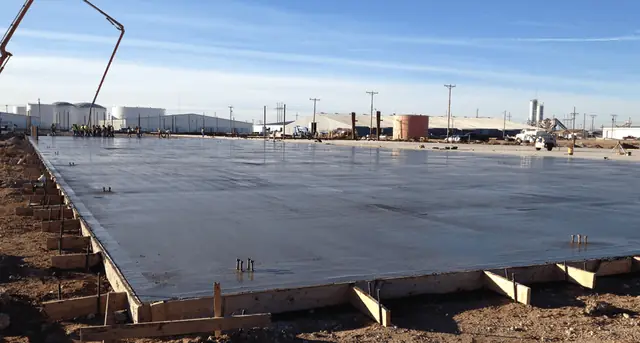
The math on a concrete order looks simple until you're standing in the driveway with a truck idling and a half-poured slab. Getting the cubic yardage right before the truck leaves the yard on Erskine Street saves you a second load, a cold joint, and an awkward call back to the plant.
The three numbers that decide everything
Every yardage calculation starts with length, width, and thickness. Measure the pour area in feet, multiply length by width to get square footage, then multiply by the thickness in feet, not inches. One cubic yard covers 27 cubic feet, so divide your total cubic feet by 27 to get yards.
- A 10x10 foot patio at 4 inches thick: 10 x 10 x 0.33 = 33 cubic feet, about 1.25 yards
- A 20x20 foot driveway at 5 inches thick: 20 x 20 x 0.42 = 168 cubic feet, about 6.2 yards
- A 30 foot by 3 foot sidewalk at 4 inches thick: 30 x 3 x 0.33 = 30 cubic feet, about 1.1 yards
What if the pour isn't a clean rectangle
Not every project is a box. A circular patio, a curved walkway, or an L-shaped pad needs a different approach, but the same underlying math. For a circle, the area is pi times the radius squared, then multiply by thickness in feet and divide by 27 the same way. For an L-shape or anything irregular, the simplest approach is to break it into two or three rectangles, calculate each one separately, then add the yardages together. It takes a few extra minutes and it's far more reliable than eyeballing an odd shape as one number.
Thickness isn't a guess, it's a decision
Four inches is standard for a walkway or patio that only ever sees foot traffic. A driveway that carries a truck or an RV wants 5 to 6 inches, and a commercial apron that takes delivery trucks all day needs more still. If you're not sure which category your project falls into, describe the load it'll carry when you call the plant and let them help you land on a thickness before you calculate yardage off it.
Full loads, partial loads, and knowing which one you need
Small jobs, a mailbox pad, a set of steps, a short section of sidewalk, don't need a full mixer load, and ordering more than the project calls for wastes money and leaves you disposing of leftover concrete. Larger jobs sometimes need more than one truck to keep the pour continuous. Rather than guess at how the plant handles smaller or split orders, describe the project when you call and let them walk you through the options that fit it.
Why the textbook number is never the order number
Sub-grade is never perfectly flat. Forms settle a little, low spots eat extra material, and some of what leaves the truck ends up outside the forms no matter how careful the crew is. Contractors commonly add 5 to 10 percent over the calculated volume specifically to cover this. Skip that allowance and you're betting the whole pour on a perfectly flat, perfectly formed site, which is not how real jobsites behave.
Ordering short costs more than ordering a little over
A cold joint, where fresh concrete meets concrete that's already started to set, is a permanent weak point in a slab. If you run short mid-pour and a second load doesn't arrive in time, that's what you get. A little leftover concrete at the end of a pour is a minor inconvenience. A cold joint running through the middle of a driveway is there for the life of the slab. When the math is close, round up.
When the number still doesn't feel right, call before you order
Every project has its own wrinkles: a stepped grade, a curved walkway, a slab poured around existing plumbing. If your measurements don't map cleanly onto a rectangle, call the plant at 806-745-1111 and talk it through before you place the order. It's a five-minute call against a mid-pour scramble, and it's exactly the kind of question the crew there answers every week. Bring whatever measurements you've already taken, even rough ones, and they can help sanity-check the yardage before the truck ever gets scheduled.
None of this replaces walking your own site with a tape measure. But going into that call with a rough number already worked out, rather than a bare description of the project, tends to get you a faster and more accurate answer, and a delivery that matches what the job actually needs.
Triple C Concrete — (806) 745-1111
Call (806) 745-1111More articles
What's Under Your Slab Matters as Much as What's In It
The ground under a South Plains slab does more work than most people give it credit for.
Control Joints and Expansion Joints Are Not the Same Thing
Two terms that get used interchangeably on jobsites, and two completely different jobs.