Control Joints and Expansion Joints Are Not the Same Thing
Two terms that get used interchangeably on jobsites, and two completely different jobs.
September 6, 2026 · 3 min read
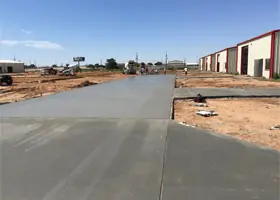
These two terms get used interchangeably all the time, and they do two completely different jobs. Mixing them up is one of the more common misunderstandings on a concrete project, because installing one where the job actually calls for the other doesn't just look wrong, it can let a slab crack somewhere nobody planned for.
Control joints: telling the slab where it's allowed to crack
Concrete shrinks slightly as it cures, and that shrinkage creates internal stress. If nothing directs that stress, the slab cracks wherever it wants, often in a jagged line straight across a driveway or patio. A control joint is a deliberate weak point, usually cut or tooled about a quarter of the slab's thickness deep, that gives the shrinkage crack somewhere clean and inconspicuous to happen instead.
- Typical spacing runs roughly 2 to 3 times the slab thickness in feet, so a 4 inch slab often gets joints every 8 to 12 feet
- Joints should be cut as soon as the concrete can support the saw without raveling, often within 6 to 18 hours depending on weather
- A joint cut too late does little good, the crack has often already happened somewhere else
Expansion joints: giving the slab room to move
An expansion joint is a full-depth gap, filled with a compressible material, placed where a slab meets a fixed object: a foundation wall, another slab poured on a different day, a column, a curb. Concrete expands and contracts with temperature, and out here that swing is real between a summer afternoon and a January morning. Without a gap to absorb that movement, the slab pushes against whatever it's butted up to, and something has to give, usually the concrete itself.
Isolation joints: the third term worth knowing
A close cousin to the expansion joint is the isolation joint, used specifically to separate a slab from a fixed feature it should never be tied to, a drain, a manhole, a light pole base, a column footing. The idea is the same as an expansion joint: let the slab move independently of the thing next to it. The material is often the same too, a compressible filler board that gets tooled or caulked at the surface once the concrete's cured. It's worth knowing the term exists so a plan that calls it out doesn't read as a third, unrelated requirement.
Where each one actually belongs
Control joints go inside a single pour, cutting it into panels. Expansion and isolation joints go at the edges, wherever the slab meets something rigid and unrelated to it: a garage foundation, an existing sidewalk, a support column, a building wall, a drain. A driveway poured against a garage slab needs an expansion joint at that seam, and the same driveway needs control joints running through the field of the pour itself. They're not substitutes for each other, and most slabs need more than one type.
What the joint material actually looks like
Expansion and isolation joints are typically filled with a compressible fiber board or foam strip set before the pour, then finished at the surface with a flexible sealant once the concrete has cured and moved through its initial shrinkage. Control joints, by contrast, aren't filled with anything structural; they're simply cut or tooled grooves left open, sometimes sealed later to keep debris and water out. Knowing which material goes where keeps a materials order matched to the joint plan instead of one generic product doing a job it wasn't built for.
We supply the material, your crew or contractor places it
Triple C stocks expansion joint material as part of our construction materials line, alongside rebar, bumper blocks, and interlocking cement blocks. Where joints go on a project is a design decision your contractor or finisher makes on-site. We'll get you the ready-mix and the joint material to the yard or the job in time to use it.
Ask before you pour if you're not sure
If a project has an unusual layout, an odd tie-in to an existing slab, or a shape that doesn't map cleanly to a standard joint pattern, it's worth talking it through with whoever's finishing the job before the truck arrives. Once the concrete is down, the joint plan is set.
Triple C Concrete — (806) 745-1111
Call (806) 745-1111More articles
How Much Concrete to Order for a Lubbock Job
Get the math right before the truck leaves Erskine Street and the pour goes a lot smoother.
What's Under Your Slab Matters as Much as What's In It
The ground under a South Plains slab does more work than most people give it credit for.